You have to prove what your packaging is made of.
The answers sit with your suppliers, not in your building. We ask them, in writing, and hand you back the finished paperwork. Asking costs nothing. You pay on the day you sign.
No card and no trial period. If you never sign anything, this never costs you anything.
Not sure you are the producer? Check it in two minutes →
What you getA signed declaration with a QR code, and one link your customers keep. Whatever you sign next is what they see, without you sending anything.See the sample ↗Press play. What is said appears here, line by line.
Since August, anything you sell in the EU needs a signed statement that its packaging follows the rules, and a file behind it saying what the packaging is actually made of — which materials, how much each one weighs, how much of it is recycled. Almost nobody has those numbers in the building. The printer who made the box has them. The mill that made the board has the rest. A laminate tube is three materials, not one, and the company that knows the third is two doors further back than the one you buy from.
The rules apply to packaging placed on the market from that date. When it was made does not matter; when it was first put on the EU market does.
The regulation’s recyclability table lists 22 packaging categories (Annex II, Table 1). Most company systems have one box marked “packaging” and a weight in kilos next to it.
For selling packaging in Germany without taking part in a system. Not registering, or a missing or wrong completeness declaration, runs to 100.000 €.
You, the printer, the board mill, the ink maker. The number you need is rarely with the company you actually buy from.
What the EU is actually asking you to do
Three things, and they are simpler than the language around them suggests. The hard part is not understanding them. The hard part is that you cannot do any of them without information that belongs to somebody else.
Which of these are yours depends on where you sell and how. The role check answers it country by country, in two minutes. Do the role check →
Be registered before you sell
In every country where you are the first to make your packaging available, you have to be on that country’s producer register first. It is a condition of selling, not paperwork you can catch up on afterwards — and the registration number is usually the first thing a customer or an authority asks you for.
Article 44
Keep a file on each pack
What the packaging is made of, how much each material weighs, how much of it is recycled material, what is in the ink and the glue. You keep the file yourself. You do not send it anywhere — until an inspector asks, and then you have to produce it. Both it and the declaration have to be kept for five years after the packaging was placed on the market, or ten years if it is reusable.
Annex VII
Sign a short statement
One page saying this packaging meets the requirements. You sign it, with your name and your company on it. It has to exist for every pack you sell, and it has to be true, which is the whole difficulty.
Annex VIII
- 1The coating on the outsideThe printer knows. You don’t.Missing from your file
- 2The ink, and how much surface it coversUsually a guess, made by the printer.Estimated
- 3The cardboard, and how much is recycledThe mill knows, one company further back.Missing from your file
You sign for all three
The declaration carries your name, but every answer sits with another company. Your question goes up the chain, and the answers have to come back down it.
Here is the part nobody explains
Your supplier does not have to file or sign anything for your product. The law puts that on the company whose name is on the finished product — on you. It does oblige him to give you the information you need (Article 16(1)), but it sets him no deadline. He is not being difficult when he doesn’t send the data; he simply has no deadline of his own. So it has to be asked for, clearly, in a form he can answer in ten minutes, and it has to be chased. That is the whole job, and it is the job we do.
This is not a mock-up
Screens from the working build, with a seeded Romanian toothpaste brand in it. Nothing on this page is a rendering of something we intend to make.
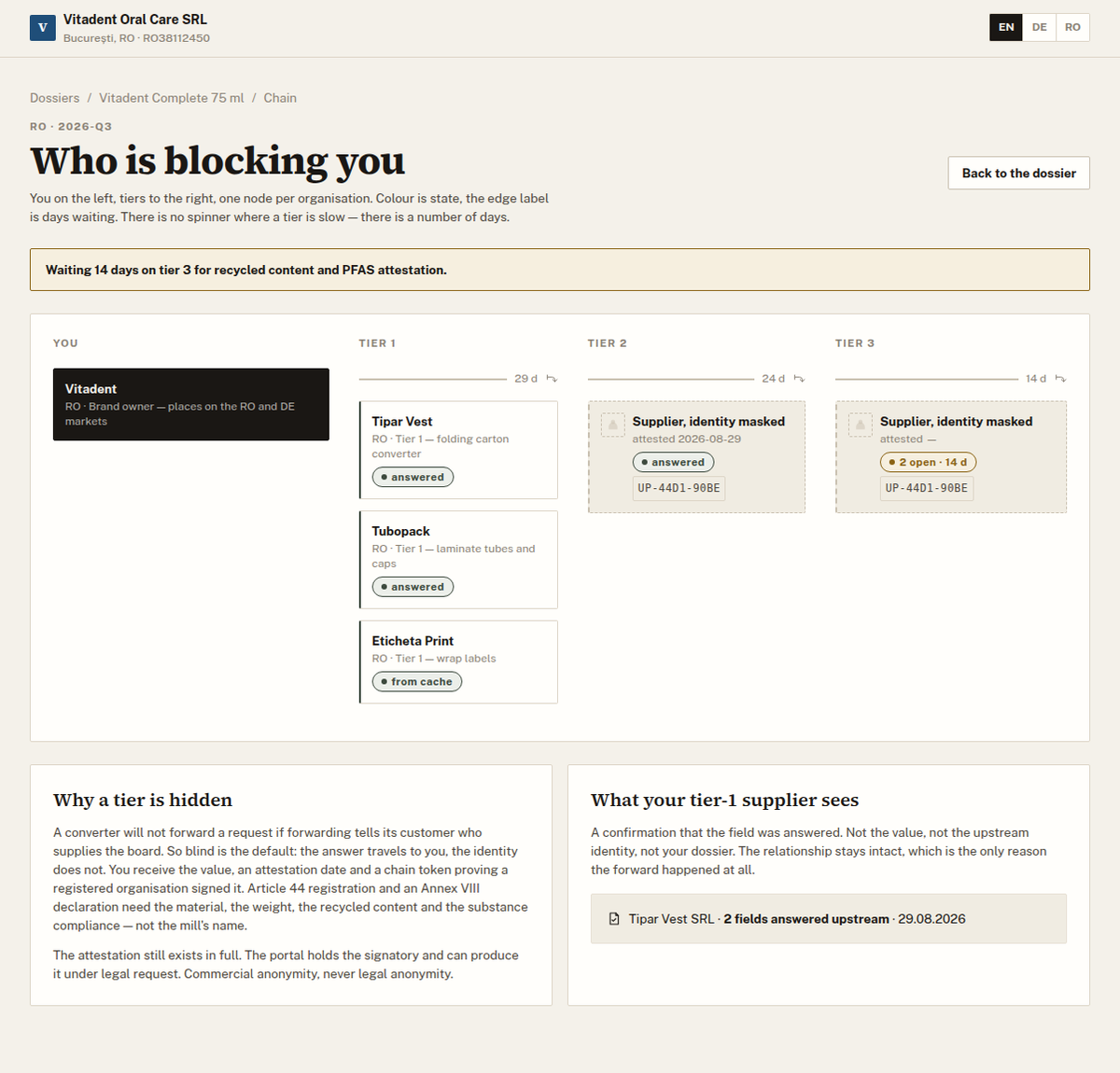
Who is blocking you
You on the left, your suppliers to the right, one box per company. Two of them are masked, because your printer will not forward a question if forwarding tells you who he buys from. You get the figure and the attestation date. He keeps his supplier. The number on each line is days waiting — there is no spinner anywhere in this product, because a spinner is not an answer.
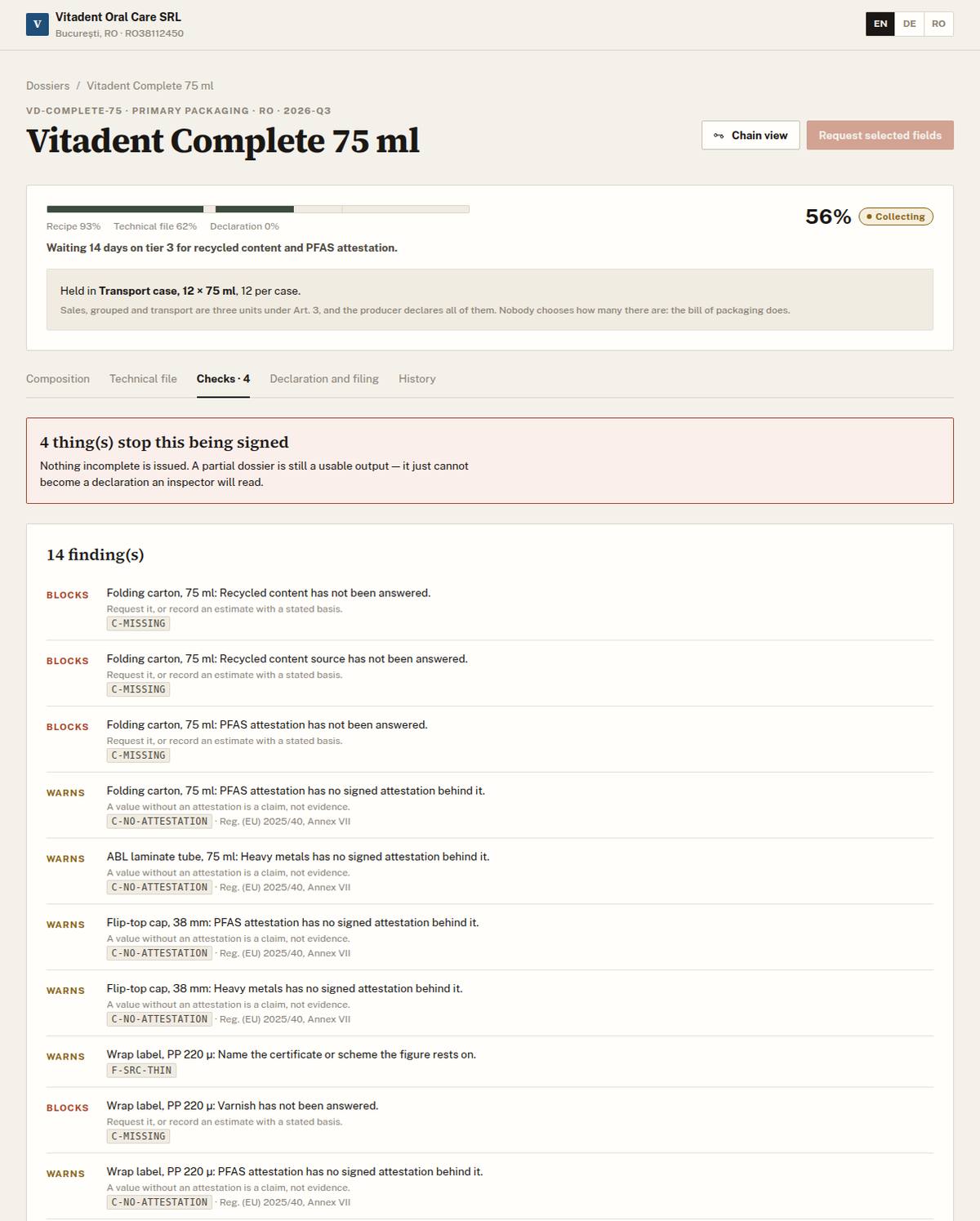
Why it cannot be signed yet
Fourteen findings, each one saying whether it blocks the signature or only warns, and which article it rests on. A partial file is still useful — it just cannot become a declaration an inspector will read, and the screen says so in those words rather than showing you a red circle.
These are real screens from the portal, taken in the demo company. We would rather show you that than a picture of a product.
Which one are you?
You put it on the market, so it lands on you
Food, drink, cosmetics, anything in a box: the company whose name is on it registers, keeps the file and signs. There is also money in this beyond avoiding trouble. If you declare a whole pack as its worst material and round up to stay safe, you may be paying a higher yearly packaging fee than measured figures would cost.
- One file per product, not one folder a yearWhen a supplier changes something, it updates, and you do not start the asking over.
- See what is missing at a glanceWhich number, which supplier, how long he has had the question.
- Your yearly report, per countryGermany counts in eight categories, Romania in seven. Same box, two different forms, and we fill both.
- Proof that holds up laterEvery figure keeps the name of who gave it and the date they did.
Answer once, and be done with the next twenty who ask
You are not our customer and you never have to become one. Answering is free and stays free. The seventh customer this quarter asking you for the same specification gets what you already sent the first one, without another form landing in your inbox on a Friday afternoon.
- One page, nothing to installIt carries your customer’s name and logo, not ours. Ten minutes, and it is done.
- Pass on what isn’t yours to answerHow much of the board is recycled is the mill’s number, not yours. If you did not make the pack at all, it goes to whoever you buy it from. One click sends the question on.
- Your suppliers stay yoursYour customer sees the figure. He never sees who you buy from.
- Change it once, everyone is toldUpdate a specification and every customer holding it hears about it. That part is paid, and it is optional.
Everything is free until you sign
Gathering the information is the slow, annoying part, and it is the part we do not charge for. Ask as many suppliers as you like, as many times as you like, for as long as you like. There is no trial clock — your suppliers take the time they take, and a fourteen-day trial would die while tier two is still answering. Nothing is billed until the day you put your name on a declaration.
- Loading in your products, from a spreadsheet or by handno limit
- Asking your suppliers, however many there areno limit
- Reminding the ones who haven’t repliedincluded
- A supplier answering his customerfree, always
- Seeing where every answer has got toincluded
- Checking each company’s VAT number against the EU databaseincluded
- The signed declaration, issued and kept up to datefrom 29 €/mo, one country included
- The technical file behind it, put together for youincluded with the plan
- Your yearly packaging report, in the form that country wantsincluded with the plan
- Asking hundreds of suppliers at once, with a progress boardfrom 900 €/mo
- Re-issuing after a supplier changes somethingno extra charge
- A folder of evidence, every number with its source and dateincluded with the plan
The reason is not generosity. If a supplier is asked to pay the first time one of his customers wants information from him, he will send a spreadsheet by email instead, and then nobody gets anything usable. The asking has to be free or the whole thing stops working.