How the packaging data actually reaches you
Take a printed cardboard box. You buy it from a printer. The printer buys the cardboard from a mill and the ink from somebody else. Each of those companies knows one piece of the answer and nobody knows all of it — so the question has to travel, and each company answers only the part that is theirs.
- A packaging question travels up the supply chain — the printer, then the mill, then whoever made the ink — because no single company holds the whole answer.
- We ask, chase, and forward the parts you don't hold. You never see who your supplier's supplier is.
- A rough guess is marked as a guess, on screen and on paper. It never quietly turns into a measured fact.
- What comes out is a signed declaration and the technical file behind it, kept true when a supplier changes something.
Tell us what you sell
The box, the tray, the label, roughly what each one weighs. A spreadsheet is fine. You do not need to know what anything is made of — that is the point of the exercise.
We ask your suppliers, in writing
Each one gets a short page with your company name and logo on it, showing only the questions that are his to answer. No account, no password, no software to install.
They pass on what isn’t theirs
Your printer doesn’t know how much of the cardboard is recycled — the mill does. He passes the question on with one click. The answer comes back to you. Who he buys from stays his business.
You get the paperwork, and then you pay
The file and the statement come out ready to sign, in the form an inspector expects, with the date and the source next to every number.
What we do, start to finish
The short version: you give us a product list, we go and get everything the law wants to know about the packaging, and you get documents ready to sign and a report ready to file. The long version is twelve steps, and the only two that need you are at the end.
- 01Take your product list however it arrives — an export, a spreadsheet, or typed in by hand.
- 02Work out which packaging you actually have to declare, at all three levels: what the product is sold in, what groups it on the shelf, what ships it.
- 03Work out which figure belongs to which company, and which of your suppliers owns each one.
- 04Check every one of those companies against the EU VAT database before a single message goes out.
- 05Write to them on a short page that carries your name and your logo, asking only for the fields that are theirs.
- 06Chase the ones who go quiet, on a schedule, until they answer or say no in writing.
- 07Pass on the questions they cannot answer to their own suppliers, without exposing who those are to you.
- 08Consolidate the lot into one record per specification — materials, weights, recycled share, coating, ink, glue — each figure carrying who gave it and when.
- 09Check that record against the rules in force and flag what does not pass, before anybody signs anything.
- 10Assemble the technical file and the declaration of conformity, in the shape an inspector expects.
- 11Keep them true: when a supplier changes something, the document is superseded and you are told.
- 12Turn the same record into the national report for each market you sell in, with the change against the last period shown.
- ·Deciding whether an estimated figure is good enough to stand behind. We will show you it is estimated; we will not decide for you.
- ·Signing. Your name, your responsibility, and we will never sign on your behalf or tell you that you are compliant.
Not every number is equally sure, and the paperwork says so
This matters more than it sounds. If a supplier gives you a rough guess and the paper shows it as a measured fact, the person who signed the statement carries the difference — and that person is you. So a guess is drawn as a guess, on the screen and in the printed file, and no setting turns that off.
Confirmed
Measured, and the company that measured it put its name and a date next to it.
Estimated
Worked out rather than measured. Shown shaded, everywhere, forever.
Still waiting
Asked for and not answered yet. Shown empty, with the number of days it has been sitting there.
Refused
The supplier said no. Written down as a refusal with his reason, rather than quietly left blank.
A file that is nine tenths confirmed and one tenth estimated is a different thing from one that looks complete. We will not draw you the second one.
Paperwork, not a dashboard
What comes out of this is documents — the kind somebody signs and somebody else reads years later. So they are made to look like records rather than screenshots, and the page your supplier sees carries his customer’s name, not ours.
This is not a mock-up
Screens from the working build, with a seeded Romanian toothpaste brand in it. Nothing on this page is a rendering of something we intend to make.
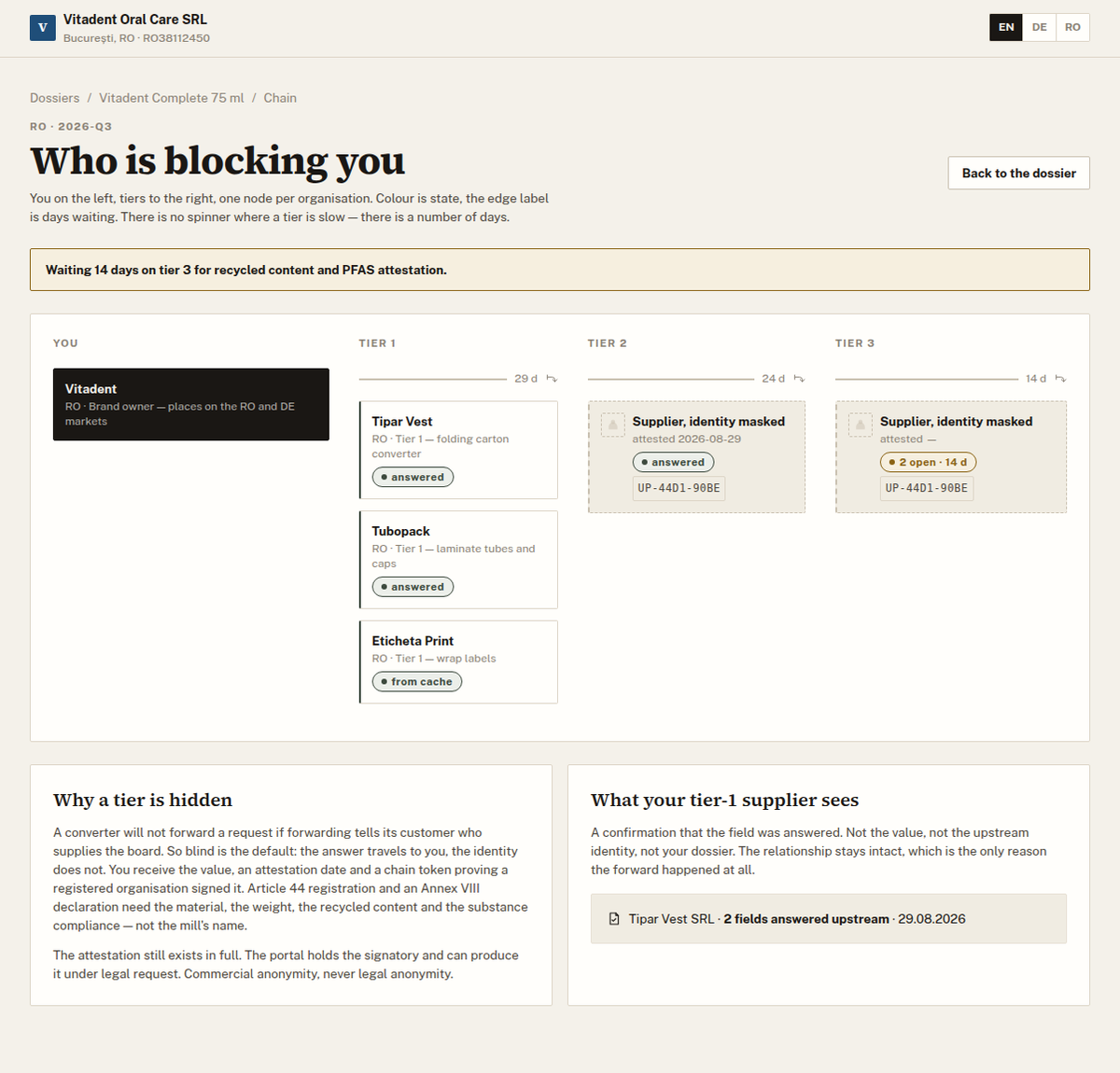
Who is blocking you
You on the left, your suppliers to the right, one box per company. Two of them are masked, because your printer will not forward a question if forwarding tells you who he buys from. You get the figure and the attestation date. He keeps his supplier. The number on each line is days waiting — there is no spinner anywhere in this product, because a spinner is not an answer.
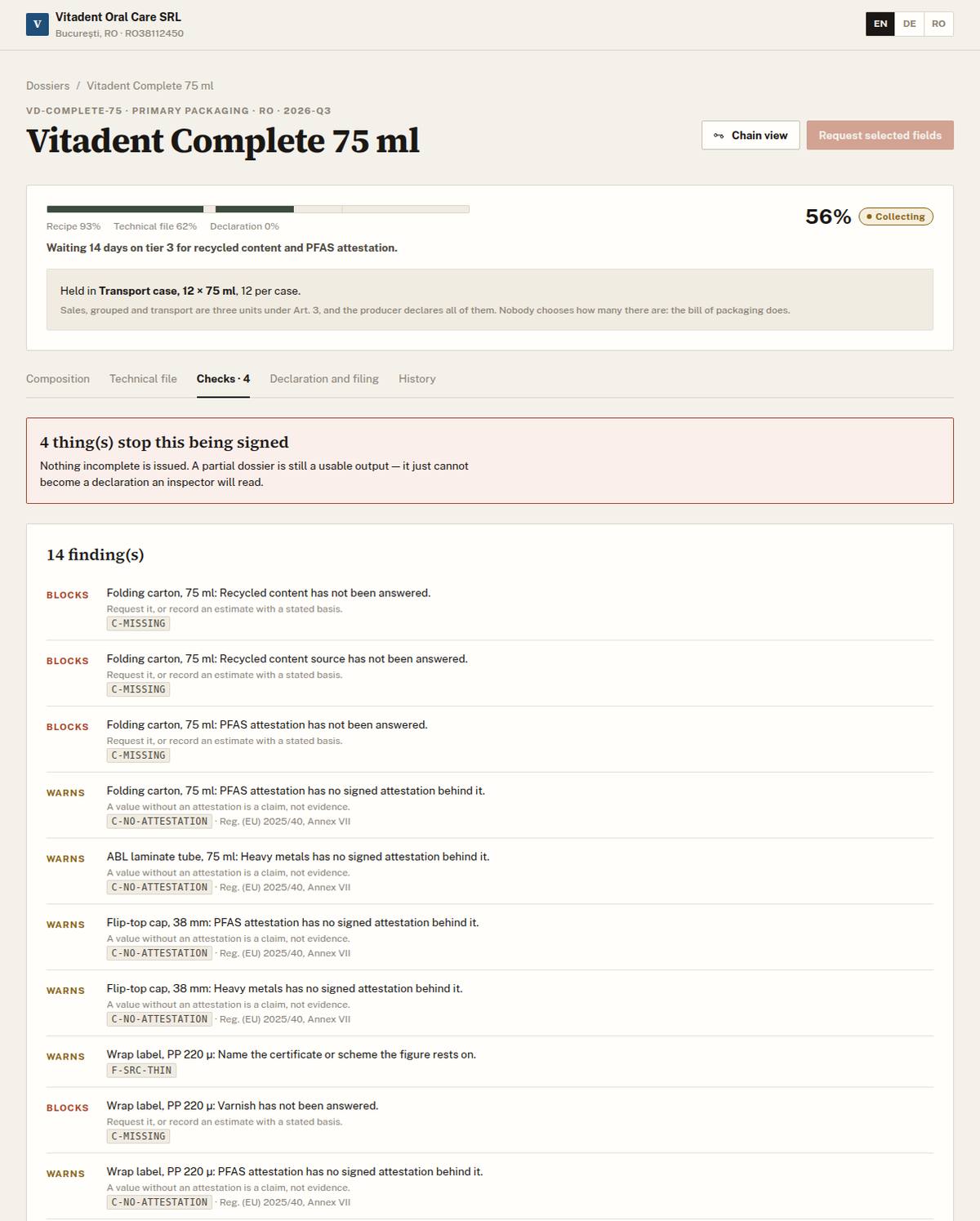
Why it cannot be signed yet
Fourteen findings, each one saying whether it blocks the signature or only warns, and which article it rests on. A partial file is still useful — it just cannot become a declaration an inspector will read, and the screen says so in those words rather than showing you a red circle.
These are real screens from the portal, taken in the demo company. We would rather show you that than a picture of a product.